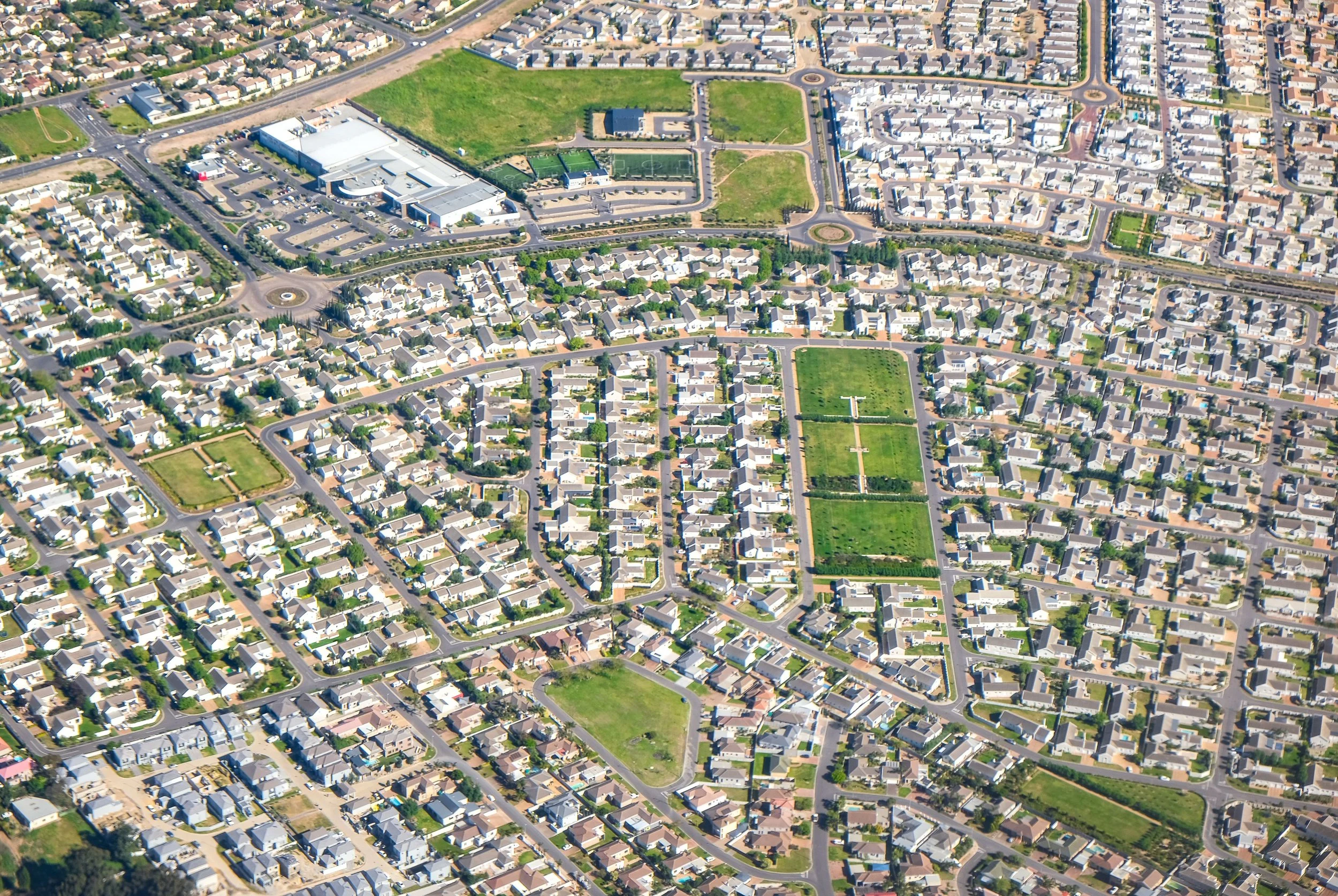
On suburban expansion, disappearing open land, and a housing market increasingly defined by the distance between where people live and where they work.
THE TRADE / MARKET WATCH / NOVEMBER 2026
Jacksonville has never been a particularly compact city.
It's a place where a thirty-minute drive can still leave you in Jacksonville. Where neighborhoods are separated by highways, shopping centers, and stretches of undeveloped land. Where the answer to almost any traffic problem seems to involve another road.
For decades, that's been part of the appeal.
More space. Larger lots. Newer homes. Room to grow.
But Northeast Florida is entering a different phase of development. The region is growing rapidly, and much of that growth is happening farther from Jacksonville's traditional urban center.
The question isn't whether Jacksonville will keep expanding.
It's what that expansion will eventually cost.
The growth is moving outward.
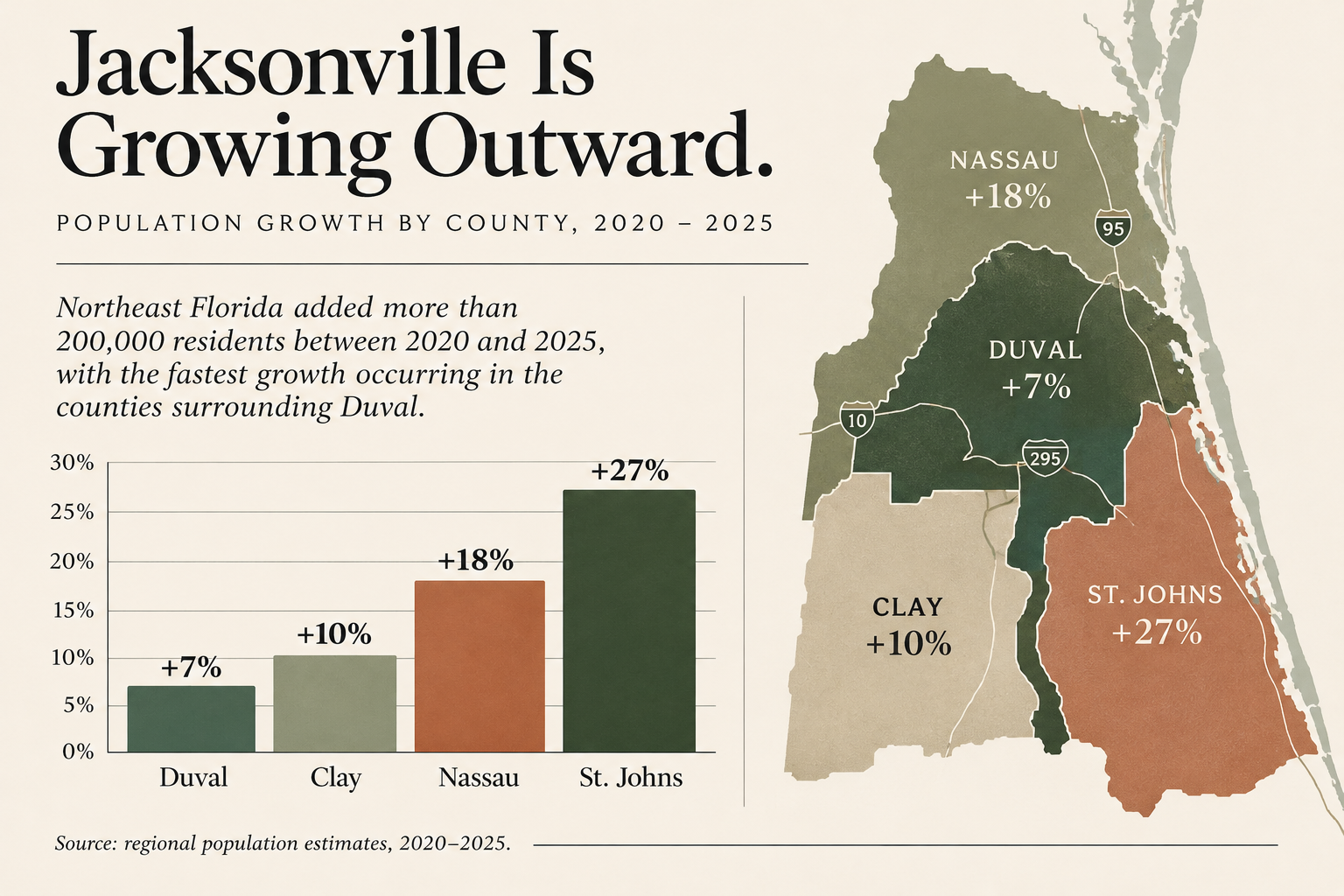
Between 2020 and 2025, Northeast Florida's seven-county region added more than 200,000 residents, bringing its population past two million.
But that growth hasn't been evenly distributed.
St. Johns County grew approximately 27% during those five years. Nassau County grew more than 18%, while Clay County grew nearly 10%.
Duval County, meanwhile, grew approximately 7%.
Jacksonville is still the region's population center, but the surrounding counties are absorbing an enormous share of its growth.
And it's easy to see why.
Drive south toward Nocatee, northwest St. Johns County, or the developing communities around County Road 210. Head west toward Oakleaf, Middleburg, and Green Cove Springs. Or travel north toward Yulee and the Wildlight area.
New subdivisions, master-planned communities, commercial centers, and road projects are changing landscapes that were substantially less developed a generation ago.
What used to feel like the outskirts increasingly feels like the next part of the city.
The market tells two different stories.
As of October 2026, the median single-family home price in Duval County was approximately $337,000.
In neighboring St. Johns County, it was roughly $564,000.
Clay County came in around $364,000, while Nassau County was approximately $478,000.
Those differences are significant.
They also reveal something interesting about Jacksonville's growth.
The region isn't simply expanding because buyers are searching for the cheapest available land.
St. Johns County, one of the fastest-growing parts of the region, is also one of its most expensive housing markets.
Buyers are often paying a premium for newer homes, master-planned amenities, school options, and the suburban lifestyle those communities offer.
That demand helps explain why developers continue building outward even while established neighborhoods within Jacksonville offer existing housing, infrastructure, and proximity to employment centers.
The appeal of a new neighborhood isn't always about price.
Sometimes it's about buying into an entirely new environment.
A highway can change the housing market.
Real estate development has always followed transportation.
In Northeast Florida, the First Coast Expressway is one of the clearest examples.
The planned toll-road corridor will eventually connect Interstate 10 with Interstate 95, including a new crossing of the St. Johns River.
Its expansion is expected to improve regional connections and make parts of Clay and St. Johns counties more accessible.
But highways don't just respond to growth.
They can help create it.
Land that once felt too remote for a daily commute becomes more attractive when a new interchange or bridge changes the route.
Developers begin planning communities. Commercial businesses follow. Eventually, the area that seemed distant becomes another established suburb.
It's a familiar pattern across Florida.
And Jacksonville has plenty of room for it to continue.
The question is whether expanding the road network can keep pace with the development it encourages.
The hidden cost of spreading out.
A new subdivision can look like an obvious success.
Hundreds of new homes. Fresh landscaping. New schools and retail centers nearby.
But development carries costs that aren't always reflected in the purchase price of a house.
Roads need to be built and maintained. Utilities need to reach farther. Emergency services must cover larger areas. Schools, drainage systems, and public infrastructure have to accommodate additional residents.
And for households, distance has a cost of its own.
A longer commute means more fuel, more vehicle maintenance, and more time spent in traffic.
A house that appears affordable on paper can become considerably more expensive once transportation is included.
None of this means suburban development is inherently bad.
People want different things from their neighborhoods, and many families genuinely prefer more space over proximity to Downtown.
But growth is more complicated than adding rooftops.
The long-term economics matter.
Meanwhile, Jacksonville already has neighborhoods.
There's another side to this story that doesn't receive nearly as much attention.
While new communities continue spreading toward the edges of the metropolitan area, Jacksonville has thousands of existing homes in established neighborhoods.
Arlington. Murray Hill. Springfield. The Westside. Northside communities. Older sections of the Southside.
These areas already have streets, utilities, schools, and residential infrastructure.
Some have housing stock that needs significant investment. Others have been steadily attracting renovations and new residents.
But they represent something that a new subdivision can't immediately recreate: an established neighborhood with decades of history.
For buyers, the trade-off can be substantial.
An older house might need a new roof, updated electrical systems, or a kitchen renovation.
But it may also offer mature trees, a larger lot, shorter trips to established employment centers, and a neighborhood with its own identity.
As Northeast Florida becomes more expensive, I think these trade-offs deserve more attention.
The next opportunity in Jacksonville real estate might not be another subdivision thirty miles from Downtown.
It might be a house that's been sitting in Arlington since 1965.
Downtown is finally part of the conversation.
For years, Jacksonville's Downtown revitalization was discussed more often than it was experienced.
There were ambitious plans, impressive renderings, and plenty of skepticism about whether meaningful change would actually happen.
But the numbers are becoming harder to ignore.
According to Downtown Jacksonville's 2025 development reporting, the urban core had approximately 9,200 residents, nearly double its population in 2016.
The development pipeline was valued at roughly $7 billion, although that figure includes projects in different stages of completion, construction, and planning.
New residential buildings, adaptive reuse projects, and mixed-use development are changing parts of Downtown.
It's still early.
Jacksonville isn't suddenly becoming a dense, walkable city on the scale of older northeastern metros.
But for the first time in a long time, its urban core is competing for some of the same investment and attention that has historically flowed toward the suburbs.
That's an important shift.
The city is effectively growing in two directions at once.
Outward into undeveloped land.
And inward, toward places that already exist.
A more selective housing market.
There's another factor complicating the picture: the housing market itself is no longer moving at the pace it did during the pandemic boom.
In October 2026, Northeast Florida had approximately 4.4 months of single-family housing inventory.
Duval County homes spent a median of 31 days on the market, while St. Johns County homes spent 49 days.
Buyers have more time to evaluate their options, and sellers are facing a market where pricing and property condition matter.
That changes the conversation around new construction, too.
When buyers have more choices, builders and existing-home sellers compete more directly.
A renovated home in an established Jacksonville neighborhood may compete with a brand-new house farther out.
The new house offers modern finishes, warranties, and often community amenities.
The older house may offer location, character, and a shorter commute.
Neither wins automatically.
But the competition forces buyers to think more carefully about what they're actually paying for.
Where does Jacksonville go from here?
Jacksonville isn't running out of land tomorrow.
That's not the issue.
The issue is whether the region can continue spreading outward without making everyday life increasingly dependent on longer drives, more infrastructure, and greater public spending.
There is room for new suburbs.
There is also enormous potential in the neighborhoods Jacksonville already has.
The most interesting future isn't necessarily one where the city chooses between the two.
It's one where existing communities receive the same level of attention, investment, and imagination that goes into building new ones.
More housing near jobs. Better connections between neighborhoods. Thoughtful redevelopment of underused properties. Preservation where it makes sense, and new construction where it's needed.
None of that is particularly glamorous.
But it may be more important than the next thousand-acre development.
Jacksonville has spent generations growing outward.
Maybe the next chapter is about making better use of what's already here.
THE TRADE — OFFERDUVAL
Jacksonville is changing. We're paying attention.
